
Understanding Co-extrusion Technology: The Science Behind Durable WPC Decking

In the engineering of modern outdoor materials, the industry has shifted its focus from simple composition to advanced surface science. Co-extrusion technology represents the pinnacle of Wood-Plastic Composite (WPC) development. For construction professionals and designers, understanding the mechanics of this manufacturing process is key to selecting materials that withstand the rigors of long-term outdoor exposure.
1. The Engineering of Co-extrusion
At its core, co-extrusion is an integrated manufacturing process where two distinct materials are extruded simultaneously through the same die.
The Structural Core: The inner core is formulated for structural rigidity and dimensional stability, ensuring the decking board can support heavy loads without deformation.
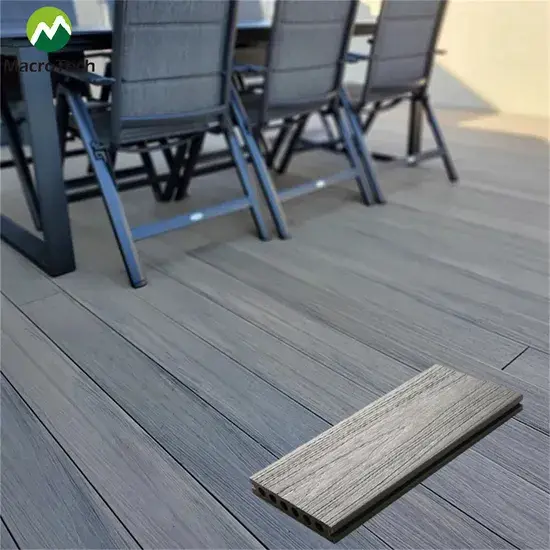
The 360-degree Polymer Shield: Unlike traditional composite boards, the co-extruded product is fully encapsulated in a high-density thermoplastic shell. This shield is engineered for chemical and environmental resistance rather than load-bearing, creating a functional separation between strength and surface protection.

2. Material Advantages in Real-World Environments
The physical properties of the protective shell provide performance metrics that are unattainable with standard composite or timber products:
Molecular Stability: The outer layer is formulated with advanced UV stabilizers that prevent the photo-degradation of pigments, ensuring long-term color retention even in high-sunlight regions.
Hydrophobic Surface: By eliminating porosity, the 360-degree shell prevents moisture absorption at the surface level. This is crucial in preventing fungal growth, mold spores, and the freeze-thaw cracking often seen in conventional composites.
Surface Hardness and Wear Resistance: The polymer shell significantly increases the Mohs hardness of the board, providing resistance to abrasion, furniture scratches, and high-heeled foot traffic, which are common failure points in residential and commercial installations.

3. Structural Integrity and Dimensional Stability
Co-extruded boards effectively mitigate the two main issues plaguing wood-based decking: thermal expansion and biological degradation.
Consistency: Because the core is shielded from humidity, the boards maintain their moisture content over time, preventing the "cupping" or "warping" that occurs when traditional wood fibers absorb and release water unevenly.
Low-Maintenance Lifecycle: By isolating the wood fibers from the environment, the material effectively removes the need for recurring chemical treatments, such as painting, staining, or sealing, throughout the product's lifespan.
Conclusion: Performance-First Design
Co-extrusion technology is not merely a manufacturing trend; it is a material science solution to the inherent limitations of organic fibers in outdoor conditions. For any high-performance outdoor installation, adopting co-extruded materials is a commitment to structural longevity and aesthetic consistency.


Comments